1. She-Knits pattern corrections.
2.She-Knits Knitting Tech video tutorials on You tube
3. Embroidery instructions (for Dumpling Bag)
4. Hand written tutorial for magnetic snap assembly
_______________________________________________
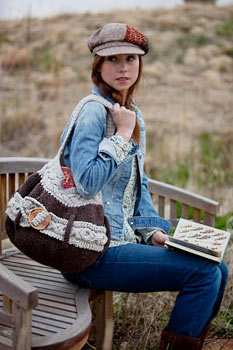
LAPORTE TOTE in Intereweave Knits Fall '09
NOT A CORRECTION, A CLARIFICATION
Many people have e-mailed me regarding confusion with Interweaves chart for the cables of the Laporte Tote. The confusion is typically because most often charts start with the right side of your knitting following the chart from the lower right hand corner reading the first row right to left. The chart for the top cable band of the Laporte Tote is knit starting with a WRONG SIDE row and therefore the chart in the magazine starts from the lower LEFT hand corner reading that first row from left to right.
If you own the magazine and would like the text directions I wrote for the pattern please contact me at sdreifuss[AT!] msn [DOT]com
-----------------------------------
KATIE BAG
Yarn Forward #14
A person contacted me on Ravelry with an error in the Katie Bag pattern in the magazine.
It’s on the directions for the Cable Pattern for the side of the bag (that eventually turns into the handles).
It is row 3: K6, p1, sl2 wyif, p1, k1 - is what is printed
it should be:
Row 3: K6, p1, sl2 wyif, p1, k6
-----------------------------------
1. She-Knits pattern corrections
LORIN The interior pocket for Lorin is worked with a single strand of Lamb's Pride Bulky. Also note there is no exterior pocket on Lorin.
_________________________________________________________________________________
2.She-Knits video tutorials on You Tube
Applied i-cord bind off with decreases
Creating strap or button holes in the round using knitted cast on
Faire Isle in the round
Tuck Stitch
__________________________________________________
3. She-Knits Knitting Tech text and picture tutorials
SHE-KNITS KNITTING TECH text and pictorial tutorials below cover techniques used within She-Knits patterns in case the lovely She-Knits knitters need more detailed information. Most She-Knits patterns that are labeled beginner or advanced beginner have this information within the pattern itself however embroidery stitches used are detailed below. Intermediate She-Knits patterns do not go in to as much detail, however details of techniques in those patterns may also be found here. Please contact She-Knits if you have any questions.
Applied i-cord cast off
This is often used to finish the top of the bag however many she-Knits patterns use applied i-cord cast off with decreases (which are noted in each individual pattern).
With backwards loop cast on cast 2 sts. on left hand needle. *K1, sl 1, k1 (this stitch will be the first stitch from the body of the bag) With the left needle, pass the slipped stitch over the last knit stitch. Slip those sts. back onto the left hand needle*. Repeat between *’s until all top of bag sts have been knitted. Cast off the remaining 2 sts. leaving a long tail.
Backwards loop cast on
*Loop working yarn and place it on -needle backward so that it doesn’t unwind. Repeat from *.
Embroidery Stitches (detailed instruction coming soon)

CHAIN STITCH
Bring the thread up at the top of the line and hold it down with the left thumb. Insert the needle where it last emerged and bring the point out a short distance away. Pull the thread through, keeping the working thread under the needle point.

FRENCH KNOT
Bring the thread out at the required position, hold the thread down where it emerges with the left thumb and encircle the thread twice with the needle (see A). Still holding the thread firmly with your thumb, twist the needle back to the starting point and insert it close to where the thread first emerged (not in the exact place or it will simply pull back through). Pull the needle through to the back, leaving a small knot on the surface, as shown, or pass on to the position of the next stitch as at B.

Lazy Daisy Stitch:
(also know as a Detached Chain Stitch)
Work in the same way as Chain Stitch (A), but fasten each loop at the center with a small stitch (B). This stitch may be worked singly or in groups to form flower petals.

Slightly Overlapping Back Stitch or Stem Stitch:
Working from left to right, bring the needle up at A, down at B, up at C, down at D. Continue this pattern to create raised effect.
I-cord
When working I-cord, work is not turned. Instead of turning the work around to work back on the WS, slide all sts to the other end of the needle, switch the needle back to your left hand, bring the yarn around the back of the work, and start knitting the sts again. After the first 2 sts, give the yarn a sharp tug. Repeat this row to form I-cord. After a fewrows, the work will begin to form a tube.
Intarsia
Intarsia is large blocks of single colors that make a design. Separate small wound balls of yarn or bobbins of yarn are used for each area of a color across the row.
Every knitter develops her/his own preference of what to do in terms of the many colors needed. For smaller sections some like to leave a long
strand of yarn dangling. Some people like to make their own butterfly center pull balls of yarn. Prepare your various yarn colors before you
begin your color work chart.
The most important part of doing intarsia work is to minimize the holes that can be created when changing colors. When you come to the edge of a
color block and want to start a new color, the NEW color is always brought up UNDERNEATH the OLD yarn strand. As you work your way up the knitting, this twists the strands around each other, connecting the edges of each color to the next. At every color joint do the same, NEW
yarn *under* OLD. This is much easier to see on the purl side of your knitting. If there are small gaps when you are done with your knitting felting will take care of much of this. If there are larger gaps it is best to use your yarns ends to neatly sew together any larger gaps before you felt your bag.
MAGIC LOOP KNITTING LINKS FOR VISUAL TUTORIALS:
Knittinghelp.com
Knitwitch.com
Magnetic snap placement on Dumpling Bag (shown on Double Dumpling)

Ribbon mounting magnetic snap (double click on written tutorial or images to enlarge) The tutorial shows how to mount the snap in grosgrain ribbon. The pictures of examples of the mounted snaps sewn in to the bags. Please contact me if you have any questions.



No comments:
Post a Comment